Summer 2026
Powering Britain’s Future: Why Clean Energy Is About Economic Modernisation – as Well as Climate Change
Destination is important
For too long, Britain’s decarbonisation and electrification debate has been framed almost entirely through the lens of climate change. That has led many people to believe that decarbonisation is only about environmental responsibility or meeting international commitments. Those objectives matter and fighting the climate emergency must be a priority, but by decarbonising our economy we can gain so much more.
We can and should also make the case that our energy decarbonisation policy is about modernising Britain’s infrastructure, improving productivity, strengthening energy security and attracting the investment that will define the industries of the future. It must be recognised as one of the central pillars of Britain’s industrial strategy.
That starts with having a clear destination. Whether or not every milestone is achieved exactly on schedule is almost secondary. What matters is establishing a credible direction of travel that gives businesses, investors and communities the confidence to commit capital and plan for the future. And we have come a long way in only a few years — the UK has reduced emissions by more than 50% since 1990 while growing GDP by around 80%— one of the strongest examples anywhere in the world of economic growth alongside decarbonisation.
The Government’s ambition to achieve clean power by 2030 is a good example. Ambitious targets shape investment decisions. They influence corporate strategy. They unlock finance that would otherwise remain on the sidelines.
And the destination is not simply a lower-carbon economy. It is a more productive, resilient and competitive Britain.
Britain will continue to need a diverse energy mix for many years. Gas will remain important, particularly for heating homes and supporting parts of industry, while nuclear will continue to provide reliable baseload generation. But the direction is unmistakable. We should steadily replace fossil fuels with cleaner sources of electricity wherever it is practical and economically sensible to do so.
This is what a modern economy will look like – and the UK is well placed to be one of the countries to lead yet another industrial revolution.
We have come so far already with renewables as the dominant source to power the nation
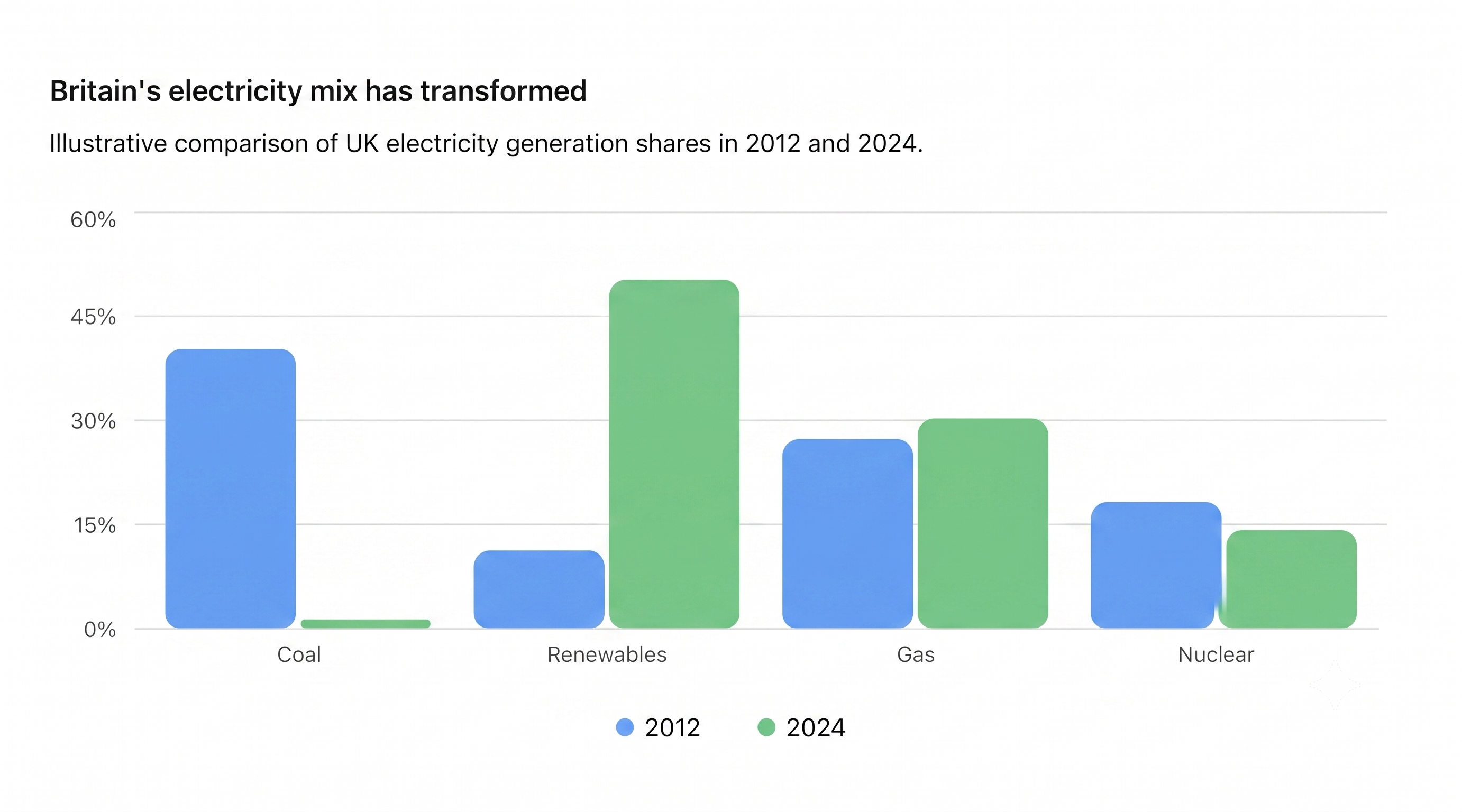
Source: Department for Energy Security and Net Zero, Digest of UK Energy Statistics (DUKES) 2025.
Energy infrastructure is imperative for growth
While Net Zero is blamed for all the cost increases in the energy sector that we are making today, it would be necessary whether we were decarbonising or not .
Britain’s electricity infrastructure has suffered from decades of underinvestment – not as bad as water but a similar trend. Much of the network requires upgrading simply to meet today’s demands, let alone tomorrow’s. Offshore wind has expanded at remarkable pace, yet the transmission infrastructure needed to bring that electricity ashore has too often lagged behind. We have frequently built generation before ensuring that the networks were in place to transport the power where it is needed. Many of our substations across the country need upgrading in any event. All the costs of renewal are put at the feet of Net Zero – they would be needed even if we still had coal on the system!
Grid connection delays are preventing investment across the economy. Projects that are ready to build factories, expand production and create jobs are instead waiting years for access to the electricity network. These are not simply energy projects. They are manufacturing plants, commercial developments and industrial facilities whose investment and jobs are being delayed because the infrastructure is not keeping pace with demand.
Investment in electricity networks should therefore not be viewed solely as energy policy. It is infrastructure policy. It is industrial policy. Increasingly, it is growth policy.
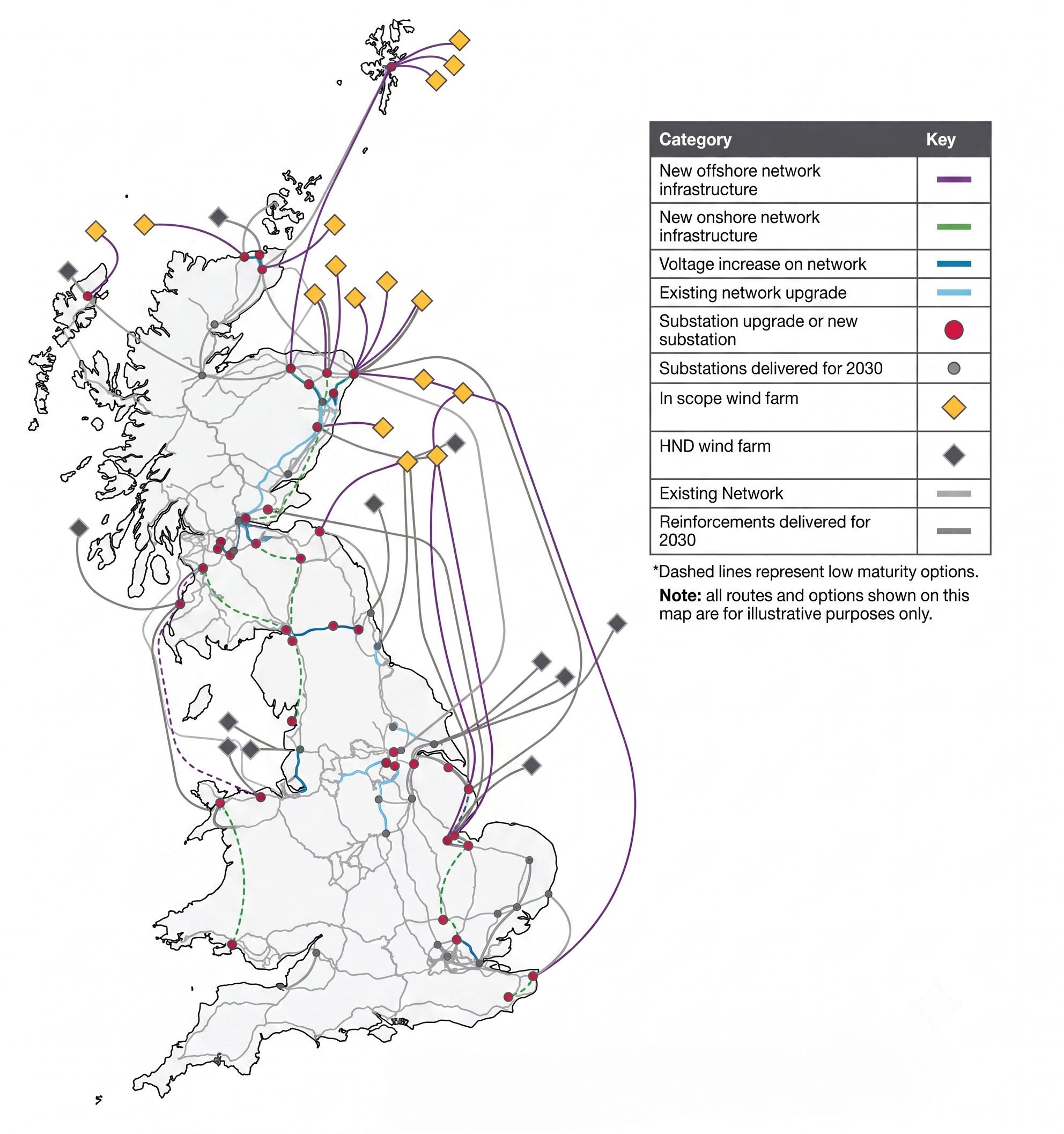
Source: National Grid ESO.
The encouraging news is that British businesses have already recognised the direction in which the economy is moving.
Across the country, manufacturers are investing in electrification and on-site generation because the commercial case increasingly makes sense. Lower operating costs, greater resilience and improved efficiency are driving decisions that are helping with climate action but also building stronger and more resilient businesses. Many companies no longer want to remain exposed to volatile international energy markets. They are taking greater control through renewable generation, battery storage and electrification.
One paper mill I have met provides a striking example. By modernising its processes through electrification, it significantly improved productivity while reducing energy costs. The motivation was not just environmental. It was competitiveness.
Domestic customers are liking their solar panels and EV cars
The same trend is emerging in our homes.
Households are increasingly installing solar panels, batteries and heat pumps, not simply to reduce emissions but to gain greater control over their own energy use and reduce exposure to volatile wholesale prices. New housing developments are demonstrating how communities can generate and manage more of their own electricity while lowering long-term costs.
People are not just buying greener technology. They are buying greater control.
EVs despite much of the media headlines are catching the public’s attention and are being bought in increasing rates with prices plummeting and the second hand market offering even cheaper electric options.
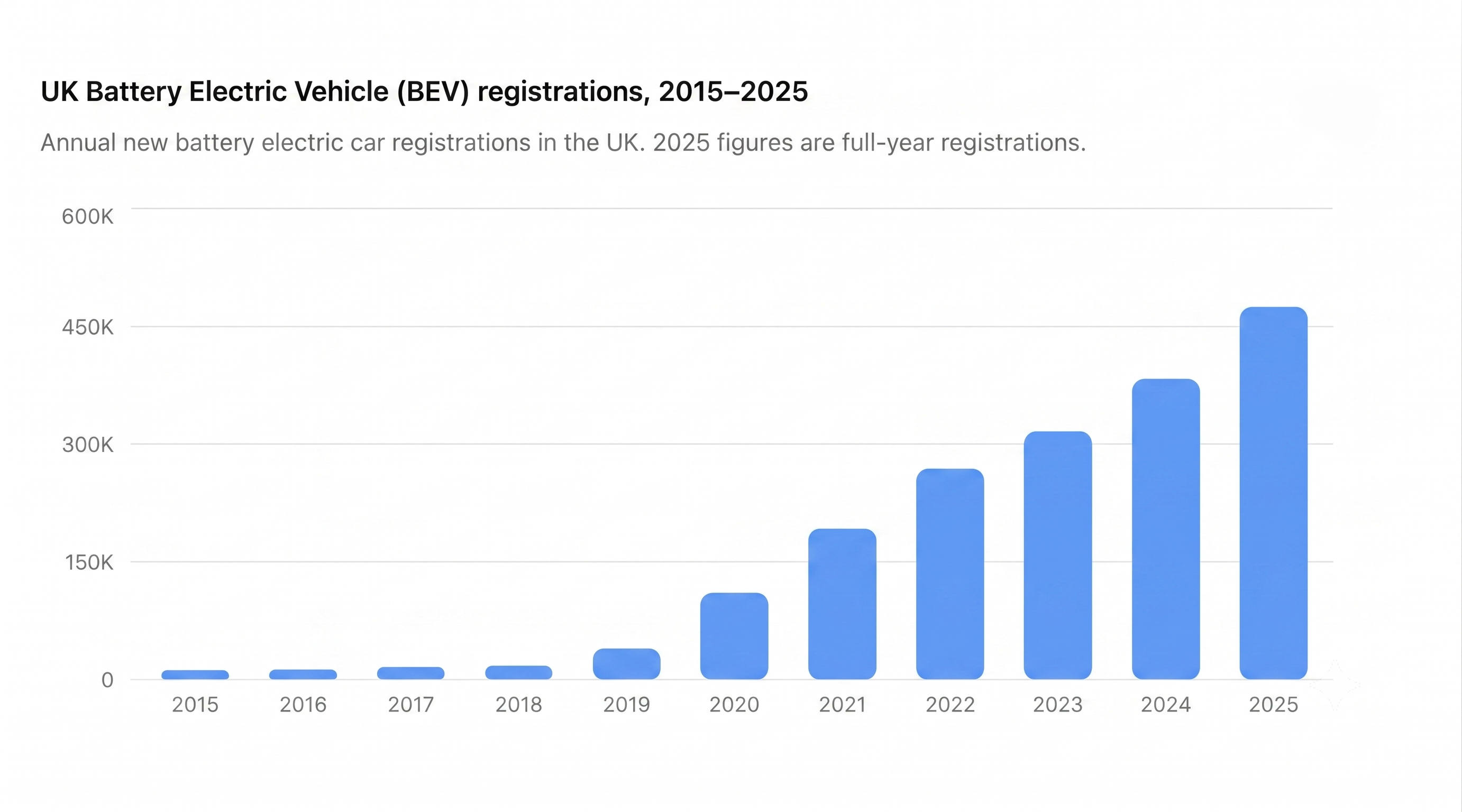
Source: Society of Motor Manufacturers and Traders, UK annual new-car registration statistics.
Investment growing
The scale of investment already being attracted into Britain’s clean energy sector is remarkable. Investment in renewable energy is running at around three times the level of the wider economy, largely because long-term policy has given investors confidence. It builds growth across the supply chains. It delivers skilled employment. And is also driving export opportunities.
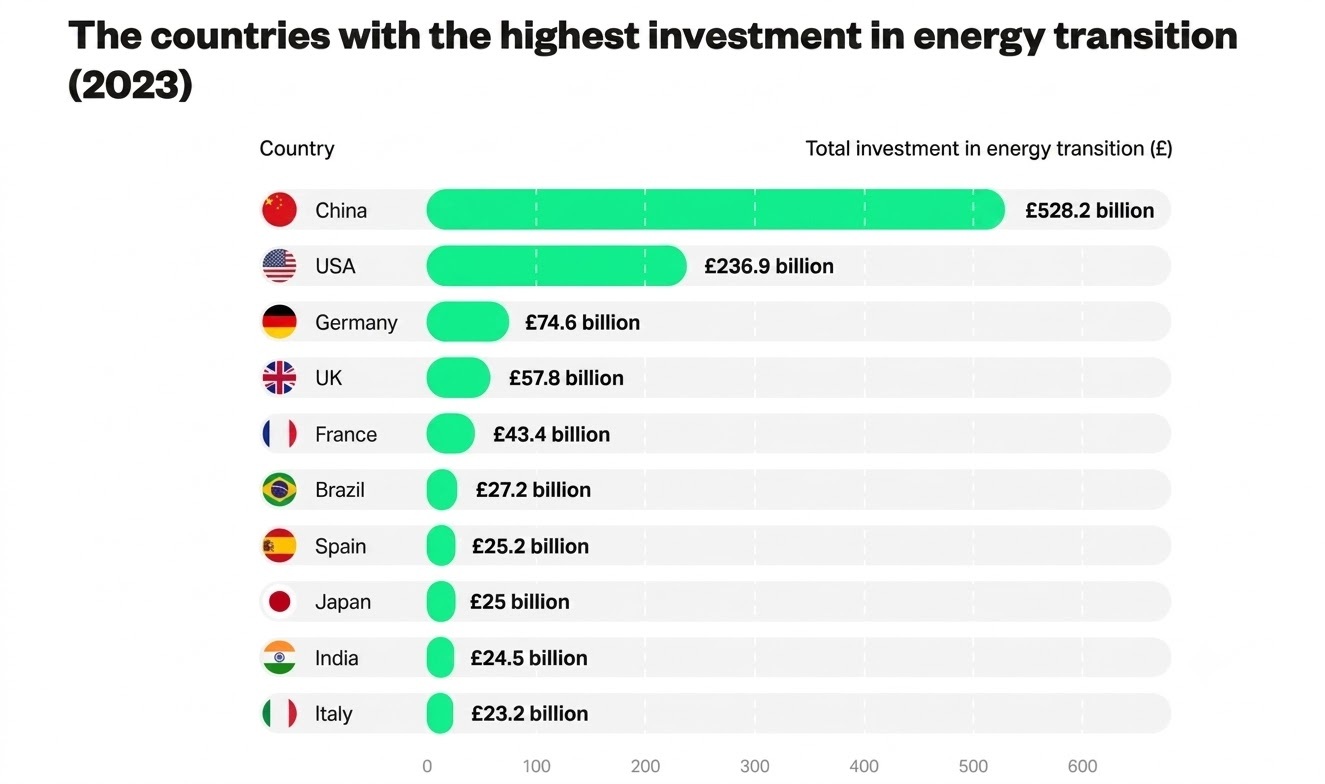
We can already see the evidence across Britain. Net Zero Economy employs 951,000 people, generates £83 billion GVA with productivity 38% higher than UK average and wages 15% above UK average
It is growing at around three times the rate of the overall economy.
SSE Transmission’s investment programme has helped attract Sumitomo to establish manufacturing facilities in Scotland with the promise from other international companies of new manufacturing sites. These factories are producing the equipment required to build Britain’s future electricity network while creating highly skilled jobs and strengthening domestic supply chains.
In Staffordshire, GE Vernova has transformed facilities that only a few years ago faced an uncertain future. Today those factories are thriving because demand for modern grid technology continues to grow.
The Humber tells a similar story. Offshore wind has stimulated investment in ports, engineering, logistics and manufacturing, creating opportunities that extend well beyond the energy sector itself.
These are not hypothetical green jobs promised for the future. They are real factories employing real people today.
Communities that were once sceptical of net zero increasingly recognise the economic opportunities arriving on their doorstep. Regional leaders of every political persuasion are now competing to attract investment because they can see the benefits in jobs, apprenticeships and local growth.
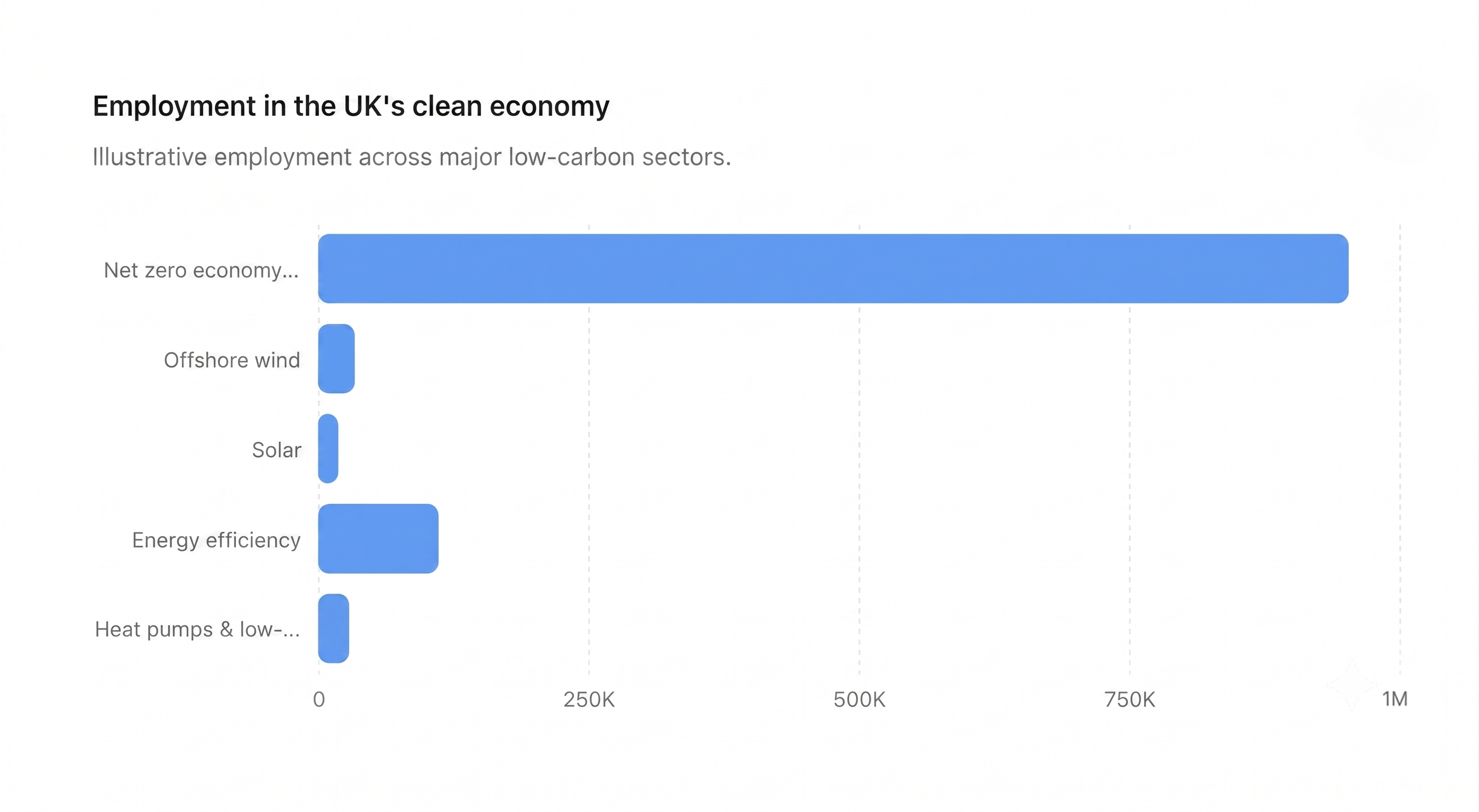
Source: Confederation of British Industry (CBI).
The debate is gradually shifting adding prosperity to the debate on tackling emissions.
Energy security a priority
The economic argument becomes even stronger when viewed through the lens of national security.
For decades Britain’s prosperity has been tied to volatile international energy markets. Russia’s invasion of Ukraine and the US/ Iran conflict demonstrates just how quickly dependence on imported fuels can become an economic vulnerability.
A system based on home-grown electricity offers greater resilience than one dependent upon imported fuel. The wind that blows across the North Sea cannot be embargoed. The tides around our coastline cannot be manipulated by hostile governments. Domestic electricity generation strengthens both our economy and our national security.
Energy security in the twenty-first century increasingly means producing more of what we consume ourselves.
A different energy system needs different solutions
The most common criticism of renewable energy is also the most legitimate. Wind turbines generate electricity only when the wind blows and solar panels only during daylight. No serious advocate of decarbonisation should pretend otherwise.
Britain is already building that flexibility. Grid-scale battery storage has grown from virtually nothing five years ago to more than 5GW today, with over 30GW in the development pipeline. National Grid now procures balancing services in seconds rather than minutes, while interconnectors allow electricity to flow between Britain and neighbouring countries as weather systems move across Europe.
Connected and smart EV cars now represent the equivalent of a nuclear power station in storage capacity with some Ohme a leading home charging company entering the capacity market with their fleet.
Longer-duration storage remains the next frontier. Pumped hydro, compressed air, liquid air energy storage and hydrogen will all have roles to play in storing renewable electricity for days or even weeks. Government’s Long Duration Electricity Storage (LDES) cap and floor support mechanism should help unlock the first wave of commercial projects.
None of these technologies is a silver bullet. Together however they form the blend of different technologies that delivers a more resilient electricity system. Just remember that we have two food crops a year and due to storage and refrigeration we eat bread and vegetables every day!
Energy efficiency the first fuel - and Cinderella of the sector
Yet perhaps the greatest untapped opportunity still remains energy efficiency.
Too often it is treated as the poor relation of energy policy, overshadowed by discussions about wind farms, nuclear stations or new technologies. In reality, improving efficiency is often the quickest, cheapest and most effective investment available.
The International Energy Agency has described energy efficiency as the world’s “first fuel” because the cheapest unit of energy is the one that never has to be generated.
The economics are compelling. Every pound invested in reducing waste frequently delivers a greater return than the same pound invested in producing additional energy.
Better insulation, smarter industrial processes, modern equipment and digital energy management reduce demand while improving productivity.
This is not simply about lowering bills. It is about making Britain’s economy more competitive. Businesses that consume less energy become more productive. Corporation tax increases. Public services reduce operating costs. Households have more disposable income. The national energy system requires less investment to meet future demand. Efficiency is one of the rare policies that benefits consumers, businesses, taxpayers and the environment simultaneously.
Yet significant waste remains throughout our economy—in buildings, industry, transport and the electricity system itself. Treating efficiency as infrastructure rather than simply as environmental policy would transform how we think about investment.
The greatest challenge is no longer technological. It is institutional.
Sequencing
Our electricity market was designed for a world dominated by large fossil fuel power stations supplying relatively predictable demand. Today’s system is becoming more decentralised, more flexible and increasingly digital, yet many of the rules governing it remain rooted in the past.
Consumers understandably question why electricity prices continue to be driven by the cost of gas even as renewable generation expands. If we want public confidence in the transition, these market arrangements must evolve.
Equally important is sequencing and blending. There is little point accelerating offshore wind if the transmission network is not ready to connect it. There is little benefit encouraging manufacturers to electrify if they face years waiting for a grid connection. Generation, networks, storage and demand must develop together.
The way we consume electricity is also changing. Large commercial users—from supermarkets to manufacturers and data centres—are becoming active participants in balancing the electricity system rather than simply passive consumers. Digital technologies are allowing demand to respond intelligently to supply, creating flexibility that barely existed a decade ago.
The energy system of the future will not simply generate electricity differently. It will use it differently too.
Customers – and Voters – Have a Veto on Net Zero
Finally, none of this will succeed without public confidence. People will support change when they can see its benefits reflected in their own lives—through lower bills, warmer homes, better jobs and stronger local economies. Infrastructure cannot simply be something imposed on communities. It must become something that creates opportunity for them.
The alternative deserves scrutiny. Some argue Britain should slow investment and continue relying on gas. But what is the realistic counterfactual? Who will finance a new generation of long-lived gas-fired power stations in an electricity market increasingly moving towards low-carbon generation? At what cost would consumers remain exposed to volatile global gas prices?
The truth is that many of those investments in a fossil fuel future simply are not going to happen. Markets have already begun moving. Capital is flowing towards clean energy because investors recognise where future demand lies. Manufacturers are electrifying because it improves competitiveness. Companies are building factories because they see long-term opportunity.
The transition is no longer driven by climate policy alone. It is being driven by economics, and is about building a stronger, more productive, more secure and more prosperous Britain.
Laura Sandys is Chair, Ofgem Energy Networks Innovation Taskforce, Non-Executive Director of SSE Transmission, and Chair of Highview Power and Electrify Industry. She is a former Member of Parliament and convenor of the Energy Geeks.