Summer 2026
Critical Minerals and the Strategic Deficit
Those of us who have spent rather too much of our lives worrying about ore grades, strip ratios, metallurgical recoveries and the cost of capital are occasionally accused of believing that every commodity cycle is a civilisational event. There is an occupational hazard in that. But on critical minerals the greater danger today is not melodrama. It is understatement.
The strategic problem facing Western economies is not that the world will somehow run out of rocks. It is that secure, qualified and scalable supply is unlikely to arrive in the volumes, forms and jurisdictions required. On even conservative assumptions, demand across a number of critical mineral chains is set to outpace secure supply. If that happens, the consequences will extend far beyond the mining sector. Economic growth will be constrained. The expansion and reinforcement of electricity systems will become more expensive. The shift of transport, heat and parts of industry away from fossil fuels will slow. Defence-industrial resilience will weaken. And the West’s dependence on China, already uncomfortably deep, will harden into a more serious strategic liability. (IEA, Global Critical Minerals Outlook 2024; IEA, Global Critical Minerals Outlook 2025.)
Let us therefore be clear at the outset about something too often blurred in public discussion. There are two strategic objectives here, and they are of equal importance: first, to secure the materials and processing chains required for decarbonisation and the wider energy transition; second, to reduce the strategic deficit to China. To imagine that the second objective will be delivered automatically as a by-product of the first is a profound mistake. It will not. The strategic deficit to China will narrow only if Western governments and Western industry act deliberately to build alternative supply chains, alternative processing routes and alternative price signals.
This is not merely an energy-transition story. It is a story about industrial capacity, strategic freedom and the ability of open societies to make and build the things on which modern life depends. Copper sits inside grids, transformers, motors, electronics, transport, construction and defence systems. Magnet rare earths matter to wind turbines, electric vehicles, robotics, drones, precision weapons and advanced manufacturing. Graphite, lithium, nickel, cobalt and battery-grade manganese sulfate underpin battery systems. Uranium is a fuel-cycle security issue for serious thinking about firm, low-carbon power. DR-grade iron ore matters if lower-emissions steel is to become an industrial reality rather than an investor presentation. Tin, tungsten and vanadium sit in smaller but strategically important markets. Silicon metal matters to solar value chains, the semiconductor and chip industries, and industrial chemistry. Phosphate rock and SOP potash are, in a different way, questions of food security and system resilience. (USGS, Mineral Commodity Summaries 2026; World Nuclear Association, World Nuclear Fuel Report 2025.)
The real bottleneck is not always at the mine gate
For too long, critical minerals policy has been framed as though it were primarily a question of digging more material out of the ground. That is much too narrow. In many of the most important markets, the decisive bottleneck lies downstream: in refining, separation, chemical conversion, purification, coating, pelletising, qualification and component manufacture. A mine-only strategy will not deliver supply security, and it will certainly not close the strategic deficit to China.
That is why the latest work from the International Energy Agency matters. Its recent outlooks make two points that should command the attention of every serious board and every serious government. First, demand associated with decarbonisation, power-system expansion and the shift of end uses away from fossil fuels remains robust. Second, supply chains are becoming more concentrated, not less. China is the dominant refiner for 19 of the 20 energy-related strategic minerals the IEA tracks, with an average share of around 70 per cent. That is not a passing distortion. It is a strategic condition. (IEA, Global Critical Minerals Outlook 2025; IEA refining concentration chart.)
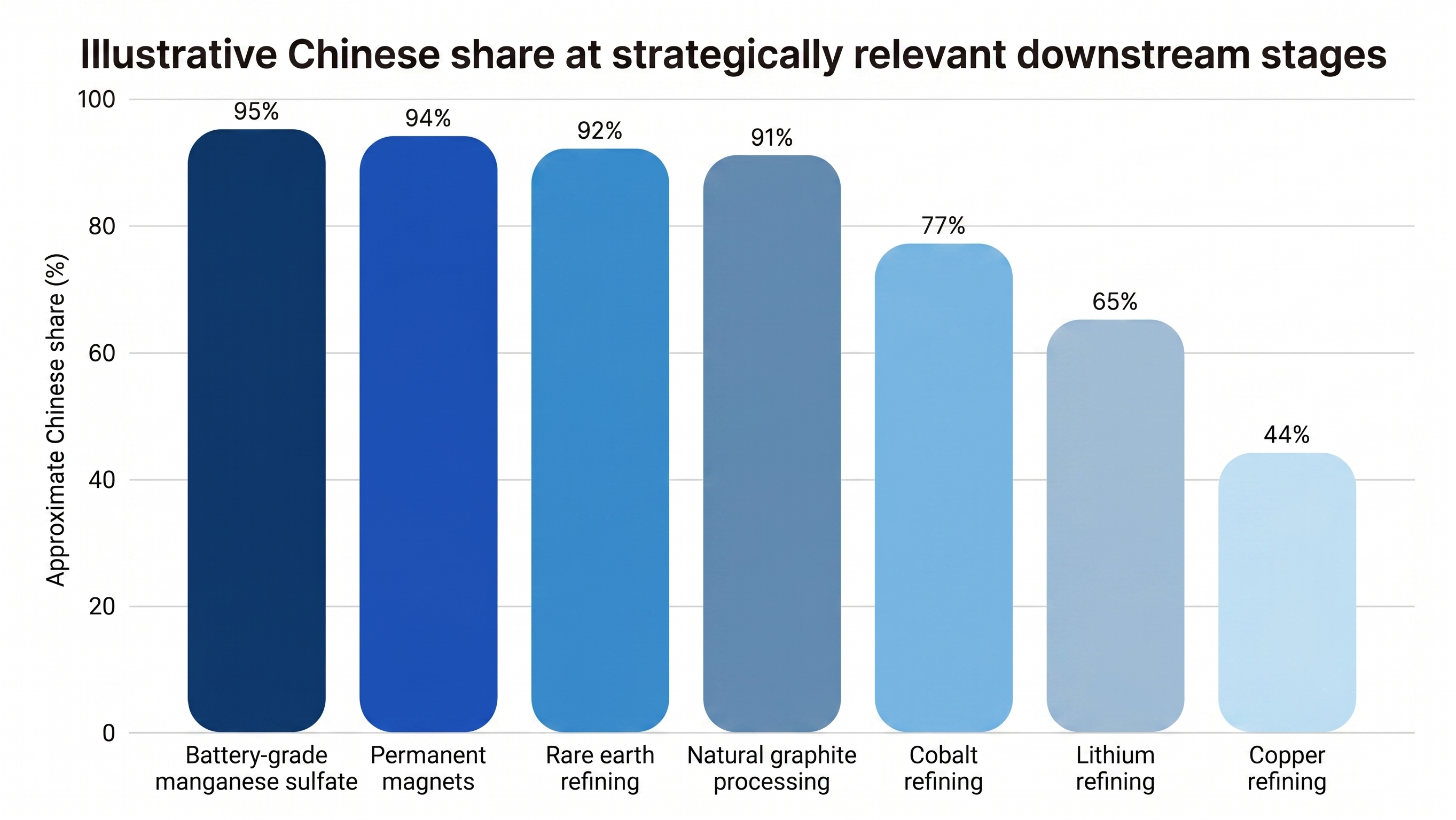
Source: Prepared from IEA work on refining concentration, battery supply chains and rare-earth magnets.
Copper is the clearest large-volume example. There is no serious route to stronger grids, larger transmission systems, expanding data centres, new charging networks or lower-emissions transport without materially more copper. Yet copper supply is difficult to bring on stream quickly. Ore grades are declining. New deposits are often deeper, more remote, more capital-intensive and more politically contested. Lead times are long. Brownfield expansions help, and they are often the fastest response, but they do not remove the need for substantial new capacity. Copper is therefore not merely another commodity market. It is a system problem.
The IEA’s analysis is sobering. On its 2035 outlook, expected mine supply from existing and announced projects meets only around 70 per cent of projected primary demand — in other words, a shortfall of roughly 30 per cent. (IEA copper chart; IEA copper commentary.)
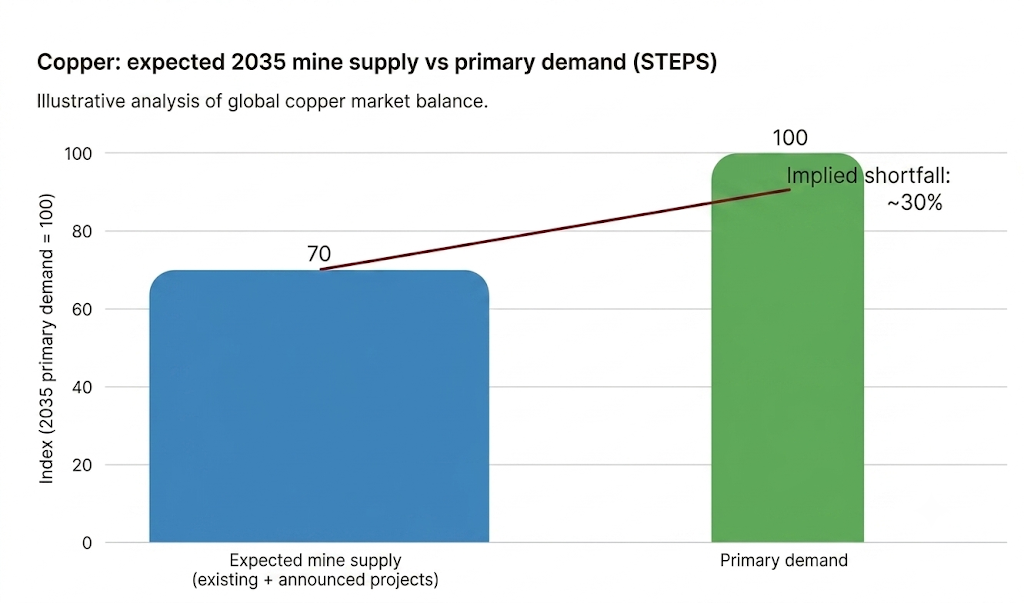
Source: Author chart indexed to 2035 primary demand = 100, based on IEA 2025 analysis indicating that expected mine supply from existing and announced projects meets around 70% of projected primary demand in STEPS.
But there are equally important markets where the problem is not sheer tonnage. Magnet rare earths are not simply a mining story; they are a separation, metals, alloys and magnet-manufacturing story. Graphite is not simply about extracting ore; it is about producing purified, spherical and coated anode material at battery-grade quality. Battery-grade manganese sulphate must remain distinct from bulk manganese ore; the strategic issue is high-purity conversion capacity outside China. Uranium is not only a mine-supply issue; the vulnerability lies in conversion, enrichment and, increasingly, HALEU capability, needed for advanced reactors and efficient smaller-footprint designs. DR-grade iron ore is fundamentally a quality, beneficiation and pelletising issue rather than a bulk-tonnage issue. These distinctions matter because they determine where capital and policy support must go. (IEA battery supply chain chart; IEA rare earth magnet chart; OECD Steel Outlook 2026.)
China’s power is expressed not only in market share, but in price
China’s position was not built overnight, and certainly not by accident. Over more than two decades it backed mining, refining, chemical conversion, component manufacture and downstream demand at the same time. It used industrial policy, state-backed finance, clustering, technical learning and strategic patience to secure control over the stages of the chain that confer the greatest leverage.
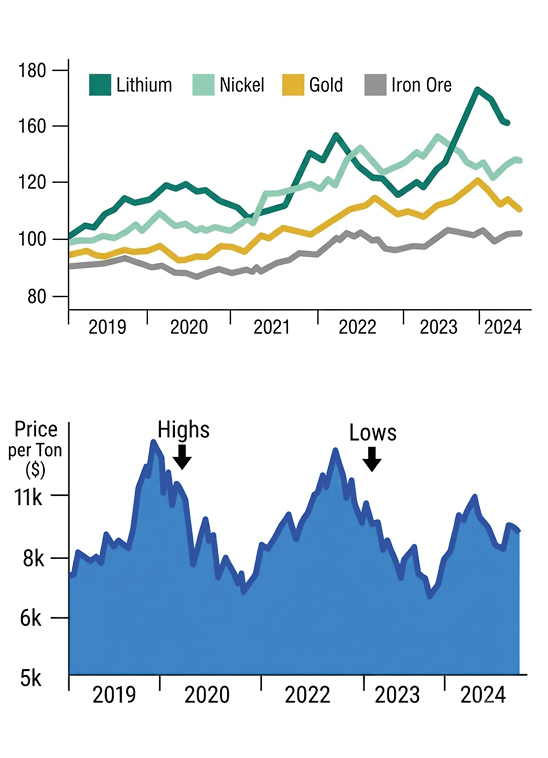
That leverage is expressed not only through concentration, but through price formation. When one country controls most processing capacity and much of the downstream demand, it can shape the commercial environment in which everyone else must operate. Capacity additions, tolerated low returns, oversupply, episodic export controls and cheaper state-backed finance can all help create price conditions that discourage investment elsewhere. Low prices in such circumstances are not necessarily evidence of a healthy market clearing efficiently. They can also be evidence of a dominant system preserving its own primacy.
Graphite is an obvious example. China dominates the graphite supply chain, and the strategic choke point is not simply mining but battery-grade processing and anode materials. The U.S. Energy Information Administration notes China’s dominant position across the chain. Syrah, which owns one of the most important ex-China natural graphite assets, said in late 2024 that synthetic graphite anode material prices were below estimated production costs and that prevailing conditions had clear effects on the willingness of customers to enter binding offtake arrangements with non-China suppliers. That is precisely how distorted price signals weaken alternative supply. (EIA, China dominates global graphite supply chain; Syrah, ASX announcement, 30 October 2024.)
Rare earths tell a similar story in a more acute form. China’s role in magnet rare earths and magnet production is so dominant that it can influence both upstream economics and downstream competitiveness. The Department of Energy’s recent work on neodymium magnets makes the point plainly: one of the key determinants of whether producers outside China can compete is their ability to secure offtake agreements with guaranteed demand. In other words, commercial bankability and strategic diversification are inseparable. (DOE, Neodymium Magnets Supply Chain Report; IEA, China’s share in rare earth magnet production, 2024.)
Silicon metal is a third example. Chinese oversupply has weighed heavily on prices. Argus reported Chinese capacity far in excess of domestic consumption, while USGS recorded lower average silicon metal prices as oversupply persisted. For a Western or allied producer facing higher power costs, tighter regulation and more expensive capital, such pricing is not an invitation to invest. It is a deterrent. (Argus; USGS, Mineral Commodity Summaries 2026.)
This is the heart of the matter. The strategic deficit to China manifests itself in two ways at once. First, the West is exposed to concentration and disruption. Second, the very prices needed to justify alternative projects can be suppressed or destabilised by the dominant incumbent system. That is why the problem will not solve itself.
Buyers say they want resilience. They still buy on lowest cost
There is an equally uncomfortable truth on the demand side. Governments are not alone in failing to price strategic risk. Many OEMs and industrial buyers do the same.
The rhetoric is familiar. Buyers speak eloquently about resilience, traceability, responsible sourcing and reducing dependence on China. Yet when procurement decisions are made, the governing principle too often remains the lowest available cost. Syrah’s own public remarks on the impact of weak pricing and policy timing on customer willingness to sign binding offtakes are revealing. So too is the DOE’s acknowledgement that ex-China projects must secure committed demand if they are to compete. Buyers say they want diversified supply; too often they are not prepared to do what diversified supply requires. (Syrah, ASX announcement, 30 October 2024; DOE, Neodymium Magnets Supply Chain Report.)
This creates a ruinous circularity. Buyers express concern about overdependence on China, but they will not sign the offtakes or pay the premiums required to make alternative supply bankable. Projects therefore stall. China retains or enlarges market share. Prices remain distorted. Dependence deepens. Then, when an export control or geopolitical shock arrives, the same buyers discover that the cheapest quoted source was not, in truth, the cheapest source at all.
There is no sophistication in shaving a few percentage points off procurement cost if the result is a structurally weaker industrial base, greater geopolitical exposure and the absence of viable alternative suppliers when they are most needed. The lowest quoted price is often not the lowest strategic cost.
Governments have begun to move — but not yet at the necessary scale
To be fair, the response is no longer merely rhetorical, particularly in the United States. Washington has begun to assemble an institutional stack rather than a list of aspirations. The Department of Energy has backed domestic lithium and battery-material projects. The Department of Defense has used Defense Production Act authorities to support mine-to-magnet capability. The Development Finance Corporation has supported non-China supply initiatives abroad. EXIM has sharpened its critical minerals toolkit. This is real progress. It is also still insufficient relative to the scale of the challenge. (DOE; DOW; DFC; EXIM.)
Europe has moved more cautiously, but not irrelevantly. The Critical Raw Materials Act goes beyond diagnosis. It sets benchmarks for extraction, processing and recycling, and creates a Strategic Projects framework intended to reduce dangerous single-country dependence. The United Kingdom has been less muscular than the United States, but more alive to the issue than is sometimes acknowledged; its refreshed strategy and export-finance support point in the right direction. Yet here too the gap remains substantial. Strategy papers are useful. Capital is better. Regulatory certainty is better still. (EU CRMA; EU Strategic Projects; EIB; UK Critical Minerals Refresh.)
What should be done now?
Five propositions seem to me unavoidable.
First, policymakers must say explicitly that decarbonisation and the reduction of the strategic deficit to China are co-equal aims. One is not a subsidiary benefit of the other. If that hierarchy is not made explicit, capital allocation, procurement and industrial strategy will continue to default to short-term cost minimisation.
Second, governments must prioritise supply chains rather than endlessly expanding mineral lists. The focus should be on the chains where vulnerability is both high and consequential: copper; magnet rare earths; graphite; lithium chemicals; uranium fuel-cycle services; battery-grade manganese sulphate; DR-grade iron ore; and a small number of defence-critical materials such as tungsten and tin.
Third, governments must facilitate brownfield expansions, common-user infrastructure and the deliberate construction of midstream capacity. Brownfield is often faster than greenfield, but it is not automatically cheap or simple. Water, power, logistics, tailings and permitting resets can delay an expansion every bit as effectively as a new mine. Without refineries, separation plants, chemical conversion, anode plants, magnet facilities, pelletising and fuel-cycle services, upstream investment will simply feed the dependency policymakers claim they wish to reduce.
Fourth, governments and strategic buyers must lower the cost of capital for strategically important projects and price resilience explicitly. If secure supply carries a public value that market pricing does not capture, then policy must bridge the gap: long-tenor loans, guarantees, export credit, first-loss capital, public-private funds and, in some cases, contracts-for-security or floor-price mechanisms.
Fifth, allied governments and OEMs must stop behaving as though the market price quoted today is the whole story. It often excludes concentration risk, coercion risk, export-control risk and system fragility. Those are real costs, even if they do not appear on a procurement spreadsheet.
Stockpiles, in a limited number of thin and coercion-prone chains, deserve serious attention as well. They are not the answer everywhere, but in markets such as tungsten, certain rare earth products and parts of the uranium fuel cycle, they can materially improve resilience.
The choice is seriousness
We should not make the mistake of treating this as a counsel of despair. The West is not powerless. We have agency. We have deep (if at times misdirected) capital markets, first-rate technical capability, sophisticated allies, mining expertise and large end-markets. But with agency comes responsibility.
If we continue to approach critical minerals through speeches, lists and communiqués, we will get more dependency, more volatility and slower growth. If, by contrast, we begin to treat secure supply chains as strategic infrastructure — and align permitting, capital, procurement and allied coordination behind that proposition — then the position is recoverable.
The choice is not between free markets and strategy. It is between serious strategy and strategic naivety.
China understood much earlier than the West that this contest would not be won simply at the mine gate. It would be won across the whole chain. Our response must now be equally clear-eyed. We need more mines, certainly. But we also need more refineries, more chemical plants, more anode and magnet capacity, more fuel-cycle capability, more allied coordination and a far more mature understanding of the cost of capital.
If we fail, we will impede economic growth, weaken our strategic position, deepen the strategic deficit to China and compromise the effort to reduce greenhouse gas emissions. If we succeed, we will do more than secure minerals. We will restore resilience, preserve industrial optionality and strengthen the economic freedom on which open societies depend.
Sir Mick Davis is Founder and Managing Partner of Vision Blue and Chair of Macsteel Global Ltd. He was previously CEO of Xstrata, and is a former Chief Executive of the British Conservative Party.